The arrival of autonomous trucking will demand more of freight operations than most organisations currently assume. That is one of the most important implications for the industry as the technology moves from trials into early commercial deployment overseas.
The first article in this series argued that autonomous trucking may arrive in Australia sooner than many expect. The second explored how it is likely to come to market – lane by lane, through specific use cases and new service models. This article looks at what that means for industry readiness.
The benefits of autonomous trucking – improved safety, reduced labour dependency, better asset utilisation, cleaner freight – will not be available equally to all. The organisations best placed to capture them are unlikely to be those that wait until autonomous trucks arrive and then ask how they might be used. They are more likely to be those that have already thought through where autonomy fits, what would need to change, and which decisions made today could open or close future options.
Readiness, in other words, may become a competitive advantage.

Readiness starts with the network
Autonomous trucking will emerge first on selected lanes, not across entire freight networks. That means readiness starts with understanding where autonomy could realistically fit – and that question is more nuanced than it first appears.
The obvious starting point is identifying which routes are busiest or most expensive. But the more useful question is which tasks have the right combination of volume, repeatability, operating conditions and commercial value to support early deployment.
Other factors matter. How predictable is the route? How complex are the roads? How often is it affected by weather, incidents or detours? How manageable are the final kilometres into each facility? Is there sufficient operational support nearby, and are the facilities at both ends prepared to receive and dispatch autonomous vehicles reliably?
A port-to-intermodal shuttle may look commercially attractive because it is repetitive and high-volume. But it may only be autonomy-ready if access routes are manageable, gate processes are structured, and handoffs at both ends can be performed without relying on ad hoc human interaction.
Early readiness work helps organisations identify where they are likely to participate in the first viable autonomous freight lanes – rather than reacting after others have shaped them.
Shared corridors or proprietary advantage?
There is a broader strategic question sitting behind network readiness.
Because autonomous trucking is likely to emerge first on specific routes, early viability may depend on concentrating enough freight volume along similar lanes. That creates an interesting tension between competition and cooperation.
Organisations may want autonomy to become a source of competitive advantage – moving early, securing preferred partners, building capability ahead of competitors. But the first viable autonomous freight lanes may not be isolated proprietary routes. They may be the corridors where multiple freight owners, operators and facilities create enough shared volume, structure and predictability to justify deployment.
"The first viable autonomous lanes may not be the most proprietary. They may be the corridors where competitors converge."
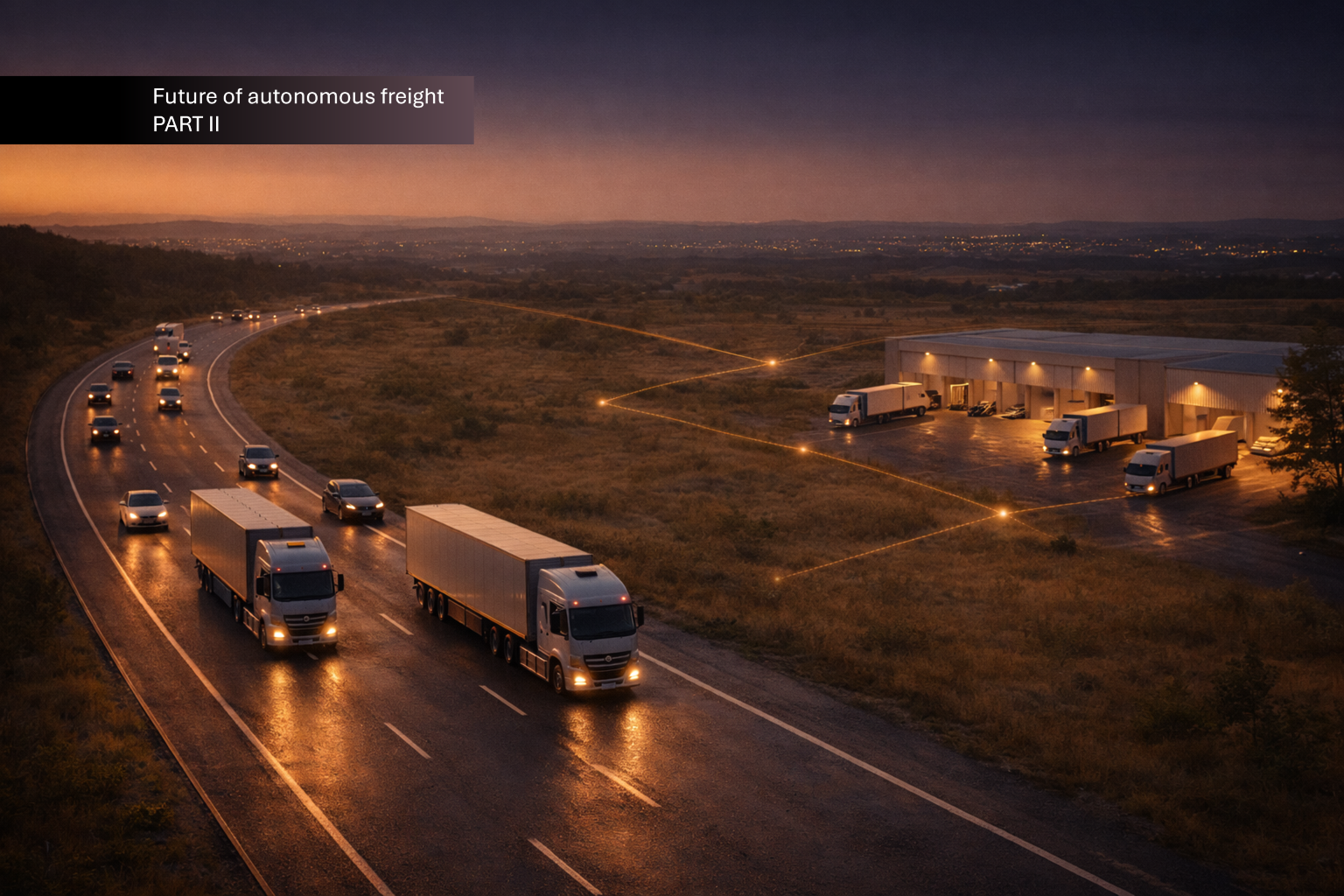
The Dallas-Houston corridor is already illustrating this dynamic. Aurora launched commercial driverless operations on the I-45 route in 2025, moving freight for customers including Uber Freight and Hirschbach Motor Lines. Bot Auto, an independent operator with its own autonomous technology, has since launched driverless runs on the same corridor for different customers. The first viable autonomous lane is becoming a shared platform – and the organisations on it are already shaping how it develops.
The history of containerisation is instructive. The container did not transform global trade because each shipping line created its own private system. It succeeded because the industry converged around standardised containers, compatible handling systems and shared infrastructure. Companies continued to compete – but the basis of competition shifted. Advantage came from how effectively they used the standardised system, not from avoiding it.
Autonomous trucking may follow a similar dynamic. Some elements – corridor readiness, access arrangements, digital interfaces, facility standards, safety protocols – may need to be shared or aligned. Competition would remain, but it may shift toward service quality, network design, utilisation and the ability to integrate autonomy effectively.
The competitive advantage may not come from owning a unique autonomous route. It may come from being best prepared to use the first viable ones.
A different performance profile
Autonomous trucks will need to be safe before they can operate commercially. But safety and commercial performance are not the same thing.
An autonomous vehicle may slow down, stop temporarily, request remote support or suspend operation in certain conditions. In many cases, that is exactly the right behaviour for a system operating within defined parameters. But it will have operational implications that need to be understood in advance.
Human-driven freight operations have their own performance constraints: fatigue, driver availability, rest requirements, incidents and weather. Autonomous trucking will have a different profile. Some issues may be less frequent but more operationally disruptive when they occur – a sensor obstruction or a stop by highway patrol due to a broken tail light or insecure load (i.e. requiring field support), a detour that takes the vehicle outside its validated route, a weather event that could halt most trucks on a lane simultaneously, or even a system problem impacting all autonomous trucks across that fleet.
"Autonomous trucking will not be perfect. The bigger issue is whether it will be better."
A key question is whether the overall performance of autonomous trucking – including its exceptions and support requirements – produces a net benefit compared with the model it replaces. Understanding that difference before large-scale deployment is considerably more useful than discovering it after.
Commercial models and contracts will need to evolve
As explored in the previous article, autonomous trucking is likely to be delivered as a service, with providers owning and operating fleets rather than freight operators purchasing autonomous trucks outright. That changes how contracts need to be structured.
A conventional freight contract focuses on capacity, price, on-time delivery, damage and liability. An autonomous freight service may need to pay closer attention to facility access, handover responsibilities, data sharing and exception management. If an autonomous truck cannot enter a facility because a digital gate process fails, who is responsible? If a route becomes unavailable due to roadworks that take the vehicle outside its validated domain, what alternative service is required? Or more broadly, what expectations or concerns would customers receiving goods transported using autonomous trucks have in terms of differences in price, service level, or risk?
Cargo owners are not exempt from these questions. Those with large freight volumes and structured operations may influence which autonomous solutions emerge and on what terms – through tender specifications, facility decisions and partnership choices. Waiting for logistics providers to deliver a fully formed solution may mean accepting terms set by others.
Facility location and design
If autonomous trucking emerges lane by lane, facilities matter – more than many organisations currently assume.
Hub, depot and warehouse location decisions already involve a wide range of considerations: land cost, customer proximity, workforce access, transport connections and planning constraints. Autonomous trucking adds another layer. A facility's suitability may be shaped by the complexity of nearby routes, motorway access, internal yard circulation, staging areas, pedestrian separation, loading bay design and gate operations. These are not just vehicle technology questions – they are property and network planning considerations.
This does not mean every warehouse or logistics hub needs to be redesigned immediately, nor that today's constraints will remain permanent as the technology matures. But organisations making long-term property and network decisions should consider whether those choices are likely to support or constrain future automation. Some constraints may be temporary. Others could become structural limitations to early adoption. The key is knowing the difference.
Systems, workflows and the discipline of dispatch
Many freight operations today rely heavily on human judgement, informal communication and practical problem-solving. A driver arrives at a gate, confirms a booking, asks where to go, navigates paperwork and resolves minor issues on the spot. That flexibility is valuable. It is also difficult to automate.
Autonomous freight operations are likely to favour more structured and digitally integrated workflows. Gate entry and exit, booking and timeslot coordination, bay allocation, load confirmation, cargo handover and proof of delivery may all need to become more predictable, with less reliance on informal interaction and ad hoc problem-solving.
The loading dock illustrates the challenge particularly well. A human driver can open a trailer, speak to warehouse staff, flag a problem and adapt on the spot. An autonomous truck cannot. Physical handling will still require human crews or automated equipment, but the coordination layer between vehicle and warehouse must become digital – bay assignments, dock authorisations and handover confirmations flowing system-to-system rather than system/person-to-person. Where something goes wrong – a damaged load, a failed dock lock, a rejected consignment – the exception pathway must be predefined and system-managed rather than resolved through a conversation between driver and yard marshal.
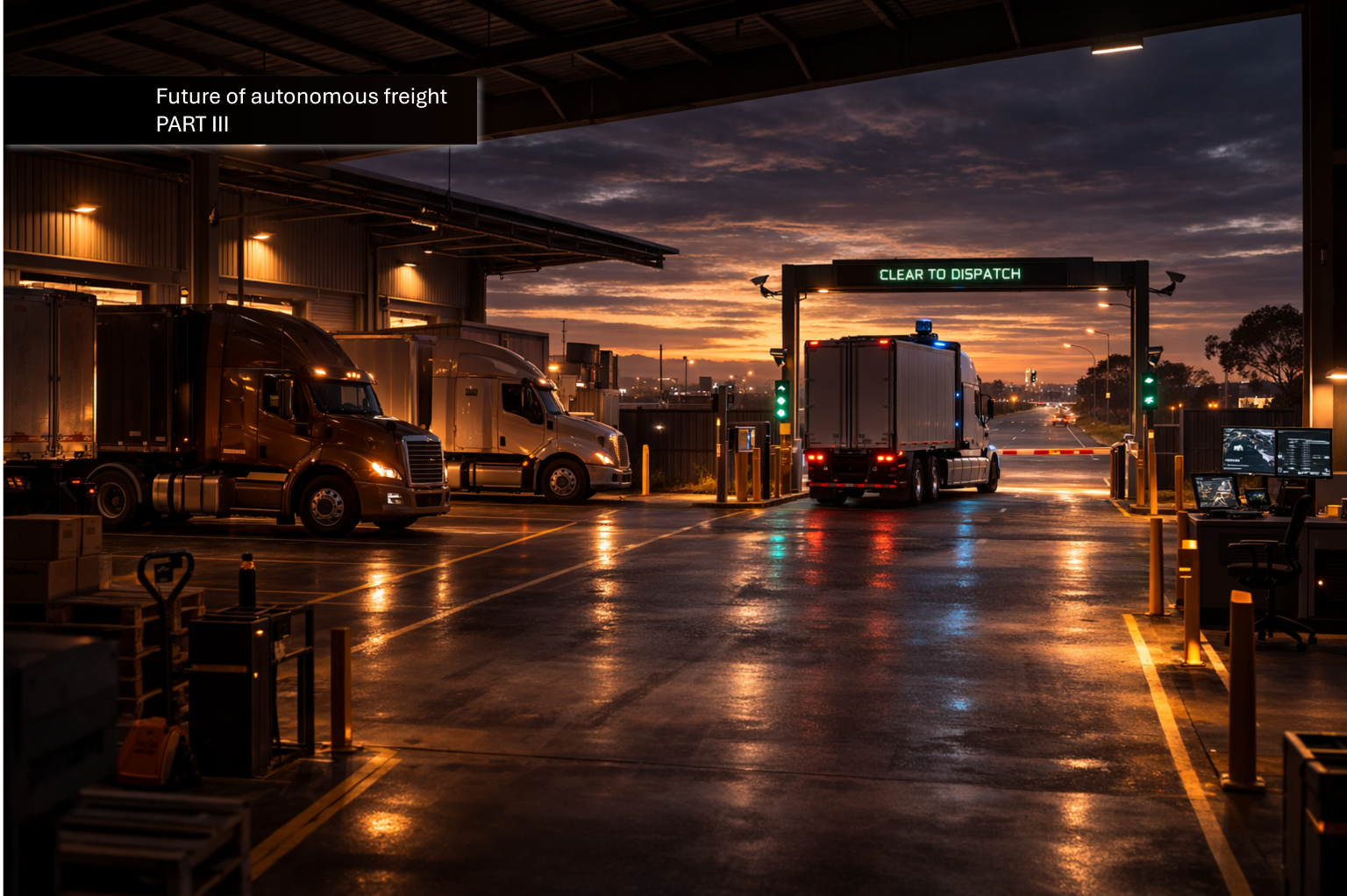
The dispatch process may also need to evolve. TMS integration could allow an autonomous truck to be assigned to a load in a similar way to a conventional truck. Yet before an autonomous truck departs on a defined route the operating model may need to confirm not just that the vehicle is ready, but that the whole mission is ready – vehicle health, route availability, forecast conditions, roadworks, destination readiness and the availability of remote or field support. Human involvement will likely be needed to resolve inevitable exceptions across each of these steps – last-minute changes, failed checks relating to the vehicle, load, or conditions.
The analogy is imperfect, but the required discipline may shift from “truck ready to depart” towards an approach more akin to “cleared for take-off”. A truck may be technically capable of completing a route, but that does not necessarily mean it should set off.
"Readiness is not about whether the truck can drive the route. It is about whether the whole freight task can be executed reliably."
Digital maturity – manifests, slot booking, yard management, gate permissions, exception alerts – may then have elevated importance, alongside the vehicle technology itself.
Human and autonomous operations will coexist
Autonomous trucking will not replace conventional operations all at once – and that transition period matters. An organisation might begin with a few routes or customer flows, while human-driven trucks continue across the rest of the network. That means human-driven and autonomous vehicles will operate alongside one another for many years, sharing corridors, hubs, yards, gates and perhaps loading bays.
This raises practical questions that are often underestimated. How should staff approach an autonomous truck? Who can authorise movement? What happens when a human-driven vehicle blocks its path? How are incidents escalated?
The workforce implications also run deeper than driver substitution. Autonomous trucking is likely to create new or expanded roles in areas such as yard coordination, remote support, field response, mission authorisation, exception handling and technical supervision. That shift should be treated as operating model redesign, not simply workforce reduction. Organisations that plan for that transition explicitly – rather than assuming it will manage itself – are likely to find the integration considerably smoother.
The case for starting now
If autonomous trucking emerges soon, have freight industry players identified where they would start, what they would expect of it, and how they would adopt it and integrate it into their operations and customer propositions?
The preparation required goes well beyond selecting a new type of vehicle. It spans network strategy, facility planning, digital systems, operating models, workforce and commercial arrangements. None of that requires major investment immediately. But it does require organisations to begin thinking now about where autonomy may fit, which decisions made in the near term could shape their position for years, and where early action could create genuine advantage.
Then what comes next? If autonomous trucks can operate more flexibly, and electric trucks can operate more quietly, the combination may reshape how freight uses the full 24-hour day.
These overlaps between autonomy and electrification – and what they could mean for freight networks, infrastructure utilisation, curfews and competitive strategy – will be explored in the next article in the series.
AVantage Insight works with freight industry stakeholders on readiness, partnership models and regulatory strategy.