This article is part of a multi-part series exploring how autonomous trucking may emerge in Australia and what freight industry stakeholders may need to consider today.
The first article outlined why autonomous trucking on public roads may arrive sooner than many expect, drawing on evidence of commercial deployment overseas and an emerging regulatory pathway in Australia.
This article explores how it is likely to come to market – and where the earliest applications may emerge.
Autonomous trucking will not be deployed across entire freight networks – it will emerge on specific routes, for specific tasks, where the operating model works.
The key question is not whether the technology works, but how it is deployed.
Rather than an “everything, everywhere, all at once” transition, deployment is likely to occur gradually – expanding lane by lane and use case by use case.
A lane-based model, not a network-wide rollout
Autonomous trucking systems are typically trained, tested and validated on specific routes – often referred to as “lanes”.
These lanes are selected based on a combination of commercial value, regulatory considerations, and technical suitability. In practice, the route – including road alignment, speeds, traffic conditions, weather and the types of scenarios likely to be encountered (such as roadworks or incidents) – must sit within the capabilities of the autonomous system.
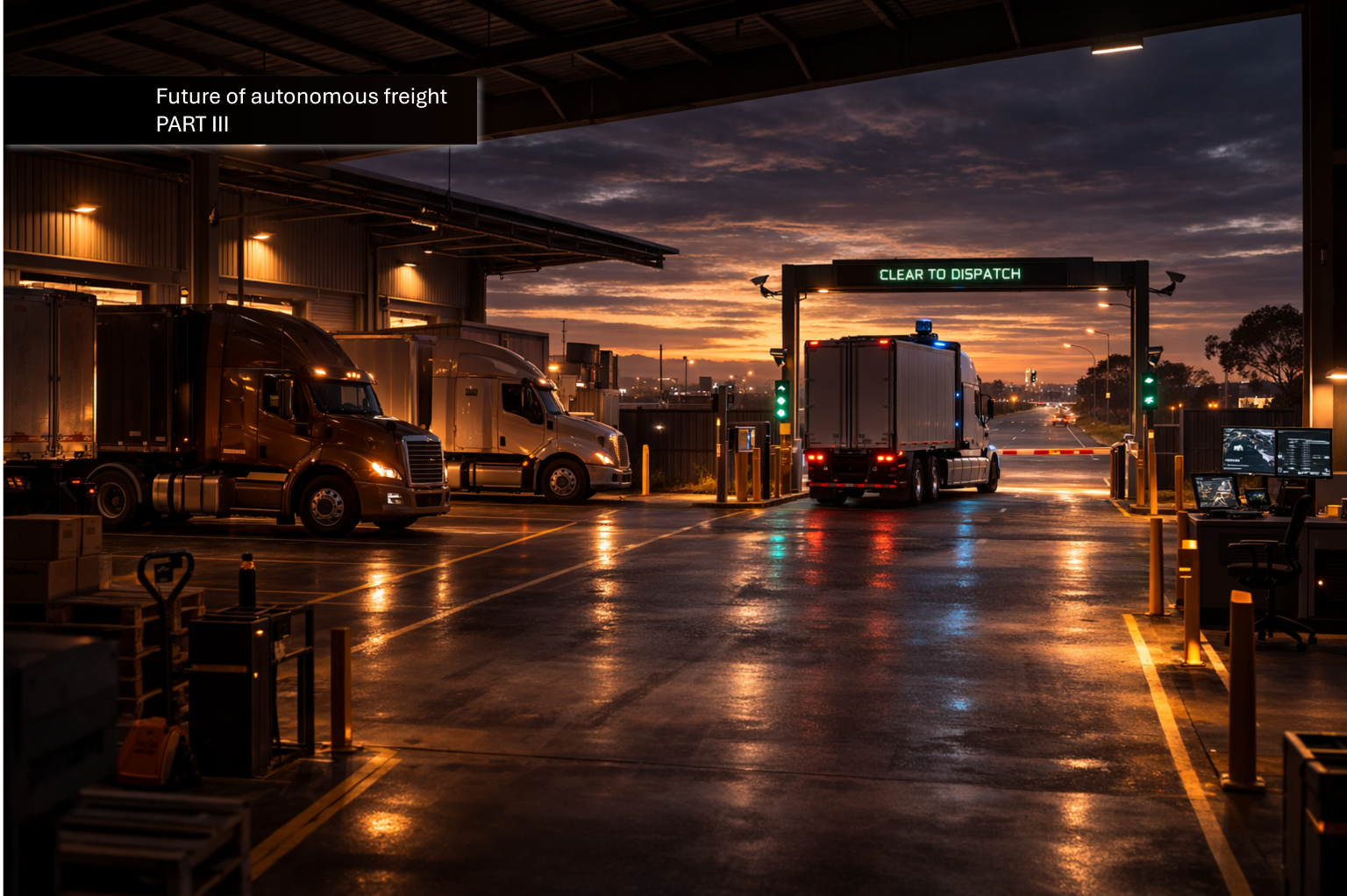
Early deployments therefore focus on high-volume, repeatable movements between known end-points such as logistics hubs, distribution centres or intermodal terminals – where both the driving task and surrounding operations can be tightly controlled.
In early U.S. deployments, this has meant long-haul transfers between outer-metropolitan hubs located close to major motorways – reflecting both current technical constraints and a deliberate staging of the operating model.
In the United States, Aurora Innovation provides a clear example of this approach in practice. Its driverless freight operations have initially focused on high-volume interstate corridors such as Dallas to Houston (~385 km), with expansion underway toward longer routes extending west to El Paso. The Fort Worth – El Paso corridor alone is approximately 1,000 kilometres, representing around 10 – 11 hours of driving time – approaching or exceeding a single driver’s allowable shift without rest. These operations are structured around transfers between logistics hubs located close to major motorways, with human drivers handling the first and last mile to customer facilities. As the network expands, this model illustrates how autonomy can extend across long-haul corridors constrained under traditional operating models.
“Autonomous trucking will not be deployed across entire networks – it will emerge lane by lane, where the operating model works.”
The hub-to-hub model is already beginning to evolve. Some operators are moving beyond motorway-adjacent transfers to serve customer terminals directly, as the technology progresses toward supporting operation on surface roads.
A different model is emerging in middle-mile logistics. Gatik, for example, operates autonomous box trucks on short, repeatable routes for customers such as Walmart, moving goods directly between distribution centres and retail locations. These routes are typically 10–50 kilometres in length, with vehicles completing multiple turns per day on fixed schedules. In Arkansas, these operations have been conducted without a safety driver onboard, with vehicles travelling on both highways and surface streets to reach customer sites. The company has also announced expansion with Loblaw Companies in the Greater Toronto Area, targeting a fleet of around 50 trucks. This shows how autonomous trucking can be applied not only to long-haul corridors, but also to structured, high-frequency movements within metropolitan and regional networks.
“Autonomous trucking is not a single model – it is emerging in different forms, aligned to different freight tasks.”
Adoption will be selective, with autonomous trucks initially operating on a relatively small number of well-defined routes.
As confidence grows and systems are validated across additional lanes, operators will progressively extend coverage.
Where autonomous trucking may emerge first in Australia
If deployment is lane-based, the next question is where those first lanes are most likely to emerge.
While much of the early focus internationally has been on long-haul freight, Australia’s freight task suggests a broader set of opportunities.
Long-haul freight corridors
Long-distance freight routes are an obvious starting point.
Australia’s major east coast corridor – connecting Melbourne, Sydney and Brisbane – shares many of the characteristics that have driven early deployments in the United States.
These routes involve long distances, high freight volumes, relatively benign weather conditions, and a heavy reliance on road transport. They are also shaped by practical workforce constraints – including extended time away from home, and fatigue management and rest requirements that do not always align neatly with the task.
Automating portions of these corridors could help address some of the most acute workforce challenges facing the industry.
At the same time, long-haul operations present additional complexity – including higher speeds, limited lighting, exposure to fauna, and more variable road conditions. Vehicles may also be operating far from support services, making it more difficult to respond to issues. Differences in regulatory readiness across jurisdictions may also add complexity on key interstate routes.
These factors do not preclude long-haul autonomy – but they do suggest deployment may be more staged than is sometimes assumed.
Metropolitan freight movements
Some of the most compelling early use cases in Australia may exist much closer to home.
Australia is a highly urbanised country, and a significant proportion of the freight task involves distributing goods within capital cities.
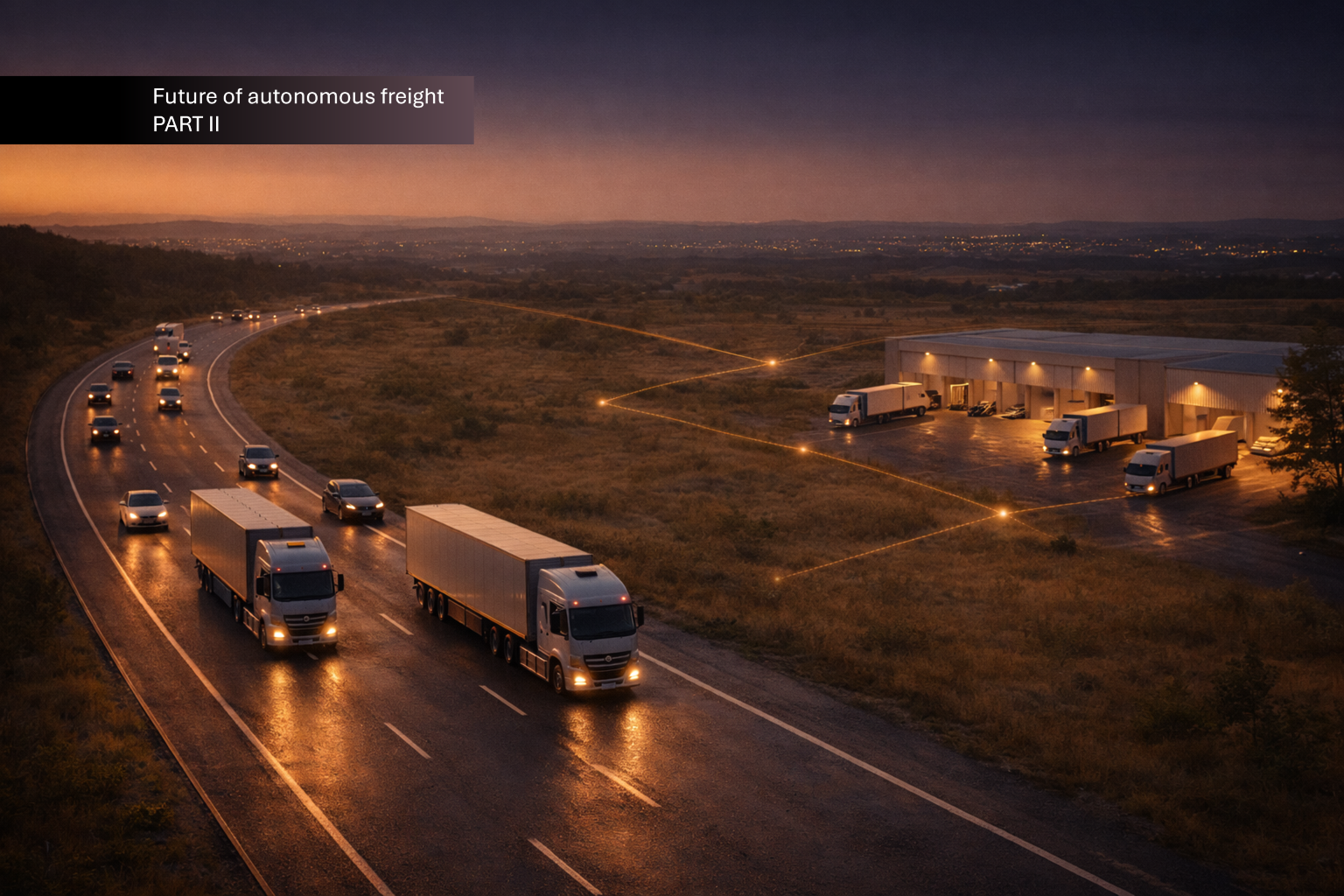
For containerised freight in particular, the vast majority of containers arriving at east coast ports are destined for locations within the metropolitan area – often within tens of kilometres of the port.
This creates a substantial and highly repetitive task of moving containers between ports, intermodal terminals and logistics hubs.
These movements are typically high volume, repetitive, and conducted along well-defined motorway corridors, connected to facilities operating on structured schedules.
Autonomous trucking is well suited to these types of movements.
While metropolitan environments are often seen as complex, these specific freight tasks are typically less complex than they appear when viewed through an autonomy lens – occurring on well-maintained, multi-lane motorways, supported by sophisticated traffic management systems and close to operational support.
“Some of the most viable early applications of autonomous trucking may be closer to home – within highly structured metropolitan freight networks.”
Unlocking overnight freight
One of the most interesting implications of autonomous trucking is its potential to shift more freight movements into overnight periods.
The freight ecosystem has long sought to move more freight at night, when infrastructure is underutilised.
In practice, this has proven difficult – constrained by receiving hours, staffing and noise restrictions.
Autonomous vehicles change that dynamic.
They do not operate on human rest cycles, allowing freight movements to be scheduled more flexibly across a 24-hour period.
When combined with electric trucks – which are significantly quieter – this creates the potential to expand overnight freight activity in ways that have previously been constrained.
This could reshape how capacity is used across both road networks and logistics facilities – not just improve vehicle productivity.
Ports and major logistics facilities, which already operate on a 24-hour basis, may be particularly well positioned to take advantage of this shift by staging freight closer to its final destination during off-peak periods.
A different commercial model
If autonomous trucking is deployed on specific lanes, the next question is how those services will be delivered.
Operating an autonomous vehicle involves more than simply replacing a driver – it requires managing an integrated system of vehicles, software, operations and infrastructure.
This includes maintaining and monitoring sensors and systems, ensuring that vehicles remain within their capabilities as conditions change along their routes, providing remote and on-ground support, and managing liability.
For this reason, early deployments are unlikely to follow traditional ownership models.
Instead, autonomous trucking is more likely to be delivered as a service – with autonomous trucking providers owning and operating fleets and moving freight on behalf of customers.
This shift is already visible. Volvo Autonomous Solutions, for example, has developed a “Transport-as-a-Service” model in which it owns and operates autonomous trucks and provides end-to-end freight services for customers such as DHL Supply Chain. Rather than purchasing vehicles, customers contract for the movement of goods, with Volvo responsible for the vehicles, autonomy systems, operations and maintenance. While still at an early stage, this model highlights how autonomous trucking may be introduced via an outcome-based model rather than an asset-based one. Other autonomous trucking developers and OEMs are exploring similar models.
This represents a shift not just in technology, but in how freight services are procured and delivered - with implications for contract structures, risk allocation and the roles of different participants across the freight ecosystem.
Implications for adoption
If autonomous trucking is deployed selectively – on specific lanes, for specific use cases – the immediate question is where those first opportunities sit.
- Which routes make the most sense to automate first?
- Where does the operating model stack up today – and where might it soon?
- And which parts of the network are most likely to see early adoption?
Beyond that, the implications run deeper.
- What does this mean for how freight networks are designed and operated?
- How do autonomous vehicles coexist alongside humans and human-driven vehicles within the same system?
- What changes in workforce could be expected, and what shifts in skills and operating models will be required?
- And how should organisations position themselves – before these decisions are made for them?
These are not theoretical questions – they are practical considerations that will shape how autonomous trucking is introduced.
The next article in this series tackles these questions, exploring what freight operators, logistics providers and infrastructure owners may need to start doing now to prepare – and how early decisions could influence who benefits most from introduction of autonomous trucking.
AVantage Insight works with freight industry stakeholders on readiness, partnership models and regulatory strategy.